Tips for Surviving Graduate and Professional School: Kindle Amazon Success Strategies
Graduate and professional school rarely breaks you with one big thing. It wears you down with a hundred small ones: the 300-page reading week, the advisor who takes eleven days to answer an email, the stipend that does not stretch to the end of the month, the quiet suspicion that everyone else understood the seminar and you did not.
What actually separates students who finish from students who stall is not raw intelligence. It is systems — for reading, writing, scheduling, money, and recovery — plus the willingness to borrow those systems from people who have already survived the process.
That is where a well-chosen Kindle library earns its keep. A short, practical guide read on your phone between classes costs less than a campus lunch and can save you an entire semester of trial and error. This guide covers how to pick those books on Amazon, three specific titles worth your time, and the underlying strategies that make any of them work.
Why a Kindle Library Beats a Stack of Advice Books
Most grad students already own too many unread physical books. The advantage of Kindle-format survival guides is not novelty — it is friction removal.
Where the Kindle format genuinely helps:
| Feature | Why it matters in grad school |
|---|---|
| Instant delivery | You buy at 11 p.m. on the night you panic, and read at 11:02 p.m. |
| Highlights + notes export | Your annotations gather in one place instead of the margins of a book you lent away |
| Adjustable text and read-aloud | Usable on a commute, at the gym, or when your eyes are wrecked from screen work |
| Whispersync across devices | Phone in the queue, tablet on the sofa, no lost place |
| Search inside the book | Jump straight to "committee," "IRB," or "budget" when you need it, not front-to-back |
| Sample chapters | Read 10% free before committing — the single best filter for thin self-help |
In practice, the sample function is the most underused tool on Amazon. A guide's first pages reveal almost everything: whether the author writes in concrete steps or vague encouragement, whether they know the difference between a master's timeline and a doctoral one, and whether the formatting survived conversion. If the sample bores you, the full book will too.
If you already travel with a dedicated e-reader, the same habits that make e-reading on long flights painless — pre-downloaded files, warm front-light at night, airplane mode to save battery — translate directly to conference travel and fieldwork.
Amazon's self-publishing arm, Kindle Direct Publishing, is why so many of these niche guides exist at all: an experienced academic can publish a 40-page manual without a traditional publisher. That is a benefit and a warning at once, which brings us to selection.
How to Evaluate a Grad School Survival Book Before You Buy
Self-published academic advice ranges from excellent to worthless. Use a checklist rather than a star rating.
1. Check the author's actual position. Look for someone who has supervised students, sat on admissions or dissertation committees, or worked in graduate student services. "Wrote a book about grad school" is not a credential; "advised twenty doctoral candidates through defense" is.
2. Match the book to your degree type. A PhD-focused guide obsessed with dissertation politics is largely irrelevant if you are in a two-year MBA, nursing, law, or pharmacy program with a fixed cohort curriculum. Professional programs run on exams, clinicals, and licensure; research degrees run on autonomy and advisor relationships.
3. Weigh length against price honestly. A 23-page guide can be worth several dollars if every page is actionable. A 250-page book padded with motivational filler is worse value at any price. Check the page count in the product details, then read the sample to judge density.
4. Filter the reviews. Ignore the star average and read three-star reviews first — they tend to name specific limitations. Look for reviewers who state their program type.
5. Check the last update. Advice about funding, remote seminars, AI writing tools, and job-market strategy ages fast. A guide last revised years ago may still be sound on time management and terrible on current application norms.
6. Verify the boring facts elsewhere. Anything involving loans, deferment, or repayment should be confirmed against the U.S. Department of Education's official portal at studentaid.gov rather than a paperback. Book advice on money is a starting point, never the final word.
Three Kindle Guides Worth a Grad Student's Attention
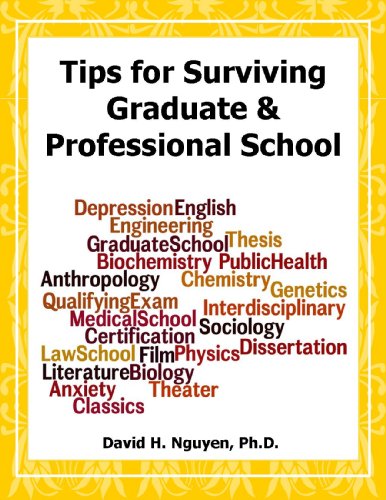
1. Tips for Surviving Graduate & Professional School — The 30-Minute Reset

The Kindle edition of a deliberately short survival guide aimed at incoming and current graduate students.
Best for: Students about to start a master's, doctoral, or professional program who want orientation-level guidance in a single sitting — and anyone mid-program who needs a quick recalibration rather than a new project.
At roughly 23 pages in a third edition, this is a briefing document, not a textbook. Its value is in the format: you can read it during a lunch break, extract three or four changes to your week, and act on them the same day. The focus sits on the perennials — protecting study time, handling academic pressure, and holding a workable line between coursework, employment, and personal life.
| Pros | Cons |
|---|---|
| Read start to finish in well under an hour | Very short, so complex topics get headlines, not depth |
| Actionable tips aimed specifically at grad and professional students | Last revised several years ago; light on current digital-workflow advice |
| Low commitment and low price for a first-week read | Self-published, so no peer review or institutional endorsement |
| Delivered instantly to any Kindle app or device | Generalist — no discipline-specific guidance |
Honest trade-off: brevity is both the selling point and the ceiling. Treat it as an orientation packet you actually read, then supplement it with a longer guide once you know which problems are really yours. The section on balancing coursework with the rest of your life pairs well with a frank look at how partnerships strain under academic pressure, because the relationship costs of a demanding program are the ones students plan for least.
Get the quick-start version of grad school before week one catches you off guard — read the sample and download it here.
2. Grad School Confidential — Strategy Beyond Survival

A more recent guide focused on the unwritten rules of navigating higher education.
Best for: Prospective applicants and current students who want the unspoken rules — how to approach faculty, how to choose a supervisor, how to keep research moving when motivation collapses.
Published in mid-2024 and running to roughly 104 pages, this sits in the useful middle ground: long enough to develop an argument, short enough to finish over a weekend. Its strongest material is on the parts of graduate education nobody formally teaches — the politics of the department, the etiquette of asking for help, and the difference between working hard and working on the things that count toward your degree.
| Pros | Cons |
|---|---|
| Recent publication, so the higher-education context is current | Brief on genuinely complex topics like funding negotiation |
| Practical strategies for both academic output and personal stability | Broad rather than discipline-specific |
| Readable, direct style that suits exhausted readers | Few extended case studies or worked examples |
| Covers common failure points, not just success habits | Assumes some familiarity with academic structures |
Honest trade-off: the "insider secrets" framing does a lot of work. Much of the advice is sound but not secret — it is simply advice your program should have given you and did not. That is still worth paying for, especially for first-generation graduate students who have no family map for this terrain.
If you want the departmental rules nobody writes down, check the current Kindle price before your next term begins.
3. Adulting 101: #Wisdom4Life — The Life-Admin Companion

A broader life-planning guide covering responsibility, goal setting and the practical side of independence.
Best for: Students moving straight from undergrad into a graduate program, and the family members buying a genuinely useful graduation gift.
Published by BroadStreet Publishing Group and running about 229 pages, this is the widest-lens book of the three. It is not about seminars or dissertations; it is about the surrounding infrastructure — planning, personal responsibility, goal setting, and the ordinary competence that keeps life from derailing your study schedule.
| Pros | Cons |
|---|---|
| Broad coverage of practical life skills and goal setting | Basic for readers who have already lived independently |
| Plain, accessible language with no jargon | Originally published in 2018; some references feel dated |
| Traditionally published, with editorial oversight | Not academic in focus at all |
| Works well as a gift for a new graduate | Longest of the three, so slower to act on |
Honest trade-off: experienced adults will skim half of it. But grad school failure is frequently a life-admin failure in disguise — missed deadlines because the calendar was never set up, financial stress because nothing was budgeted, health problems because nothing was scheduled. If that is your pattern, this book targets the actual root cause.
Buying for a new graduate? Send the Kindle edition as a gift and it arrives on their graduation day.
Quick Comparison
| Tips for Surviving Grad & Professional School | Grad School Confidential | Adulting 101 | |
|---|---|---|---|
| Approx. length | 23 pages | 104 pages | 229 pages |
| Reading time | Under an hour | A weekend | Several sessions |
| Focus | Fast orientation | Academic strategy and department politics | Life skills and planning |
| Best stage | Pre-enrolment / first week | Any point in the program | Transition out of undergrad |
| Publisher type | Self-published | Self-published | Traditional |
The Strategies That Make Any of These Books Work
Books supply the ideas. These are the mechanics that convert them into a finished degree.
Build a Weekly Operating System, Not a Daily To-Do List
Graduate work has almost no external structure. Left alone, it expands to fill every waking hour and still feels incomplete.
Run your week on fixed blocks instead of tasks:
- Two deep-work blocks per day, 90 minutes each, on your hardest cognitive work — writing, analysis, problem sets. Phone in another room.
- One admin block, ideally late afternoon when focus drops — email, forms, scheduling, reimbursements.
- One weekly review, 30 minutes, same time every week. Look back at what moved, look forward at deadlines two weeks out, and rewrite next week's blocks.
- One genuinely protected day off. Not "a day where I only do a little reading." Off.
A common mistake is scheduling only the deadlines. Deadlines are outputs; blocks are inputs. If you protect the inputs, the outputs handle themselves.
Triage the Reading Load
You will be assigned more reading than any human can read closely. This is intentional — you are being trained to extract argument, not to memorise text.
Use three tiers:
- Tier 1 (close read, ~20%): core theory, methods you will use, anything you will be examined on.
- Tier 2 (structural read, ~50%): abstract, introduction, section headings, conclusion, figures. Enough to discuss it intelligently.
- Tier 3 (reference only, ~30%): know it exists, know its claim in one sentence, log the citation.
Decide the tier before opening the file, not thirty pages in. Kindle-format readings help here: highlight only claims you could defend in a seminar, then export the highlights into your reference manager weekly.
Manage the Advisor Relationship Deliberately
This single relationship determines more of your experience than your coursework does.
- Send a short agenda 24 hours before every meeting: three bullet points, one decision needed.
- Send a three-line summary after every meeting confirming what was agreed. This prevents the "that's not what I asked for" cycle six months later.
- Ask directly about expectations — contact hours, response times, authorship, chapter turnaround. Vague expectations cause more conflict than demanding ones.
- Build a second and third mentor outside your committee. Sole dependence on one person is a structural risk, not a personal failing.
Treat Money as an Academic Variable
Financial stress steals cognitive capacity that you need for your work. Map your stipend, tuition remission, assistantship hours, and loan obligations onto one sheet before term starts, and confirm anything involving federal loans against official guidance rather than forum rumours. Know your program's rules on outside employment before you take a job — many funding packages cap it.
Protect Health Before It Becomes Urgent
Sleep, movement and food are performance infrastructure, not rewards for finishing. The practical minimums that hold up under a heavy term: a consistent wake time, one form of movement you would do even on a bad day, and food that does not require decisions when you are depleted.
Two more small levers that matter more than they sound. First, know your institution's counselling service intake process before you need it, because finding out during a crisis is a barrier in itself. Second, do something about the physical environment — a windowless office or basement lab is genuinely demoralising, and a plant chosen for tolerance of dim rooms is a cheap fix. If you are unsure what will actually survive your desk, the rules for keeping greenery alive indoors are simpler than most people assume.
Turn Your Kindle Highlights Into an Actual Study System
Buying the book is easy. Extracting value from it is a workflow.
- Read with a purpose statement. Before opening, write the question you want answered ("How do I stop losing Fridays to email?").
- Highlight sparingly. If more than 10% of a page is yellow, you are highlighting comfort, not information.
- Export weekly. Pull your highlights into a single notes file — one per book, dated.
- Convert to three actions. Every book should produce a maximum of three changes you will actually make. More than three and none will stick.
- Review at 30 days. Did the changes survive? Keep what worked, discard what did not, and re-read only the sections tied to failures.
This is the difference between having read twelve grad school books and having benefited from one.
Common Mistakes Students Make with Advice Books
- Reading instead of working. Self-improvement reading can become sophisticated procrastination. Cap it at one guide per term.
- Adopting a whole system at once. Nobody successfully installs a new calendar, note system, reading method and morning routine in the same week. Change one thing.
- Trusting generic advice on program-specific rules. Progression requirements, funding conditions and licensure deadlines come from your handbook and your graduate office — never from a book.
- Buying long when you need short. In a crisis week, a 23-page guide you finish beats a 300-page one you abandon.
- Ignoring the sample. Ten percent free is enough to judge tone, density and formatting. Use it every time.
Practical Preparedness: The Part Grad Guides Skip
Almost no academic advice book mentions this, but a semester can be derailed by a power cut during finals, a campus closure, or a storm that traps you away from your lab.
Keep a small, boring kit within reach of your desk: a charged power bank, a headlamp, bottled water, a few days of medication, copies of key documents, and offline backups of your thesis on two separate drives. If you have never assembled one, a straightforward walkthrough of what belongs in a basic kit covers the essentials in an evening, and it is easy to build without overspending if you start from a list of affordable core supplies.
Students in coastal or storm-prone regions should go a step further, since university housing is rarely stocked in advance — a checklist of what storm-season preparation requires is worth reviewing before term begins, not after a warning is issued. The general principle holds across all practical guides, whether the subject is coursework or the field: the well-structured, checklist-driven format of a good practical handbook beats vague reassurance every time.
Frequently Asked Questions
Are self-published Kindle grad school guides worth buying?
Often, yes — but judge them individually. Self-publishing lets working academics release specific, useful material that no traditional publisher would take on. It also removes editorial quality control. Read the free sample, check the author's actual experience with graduate education, and read the three-star reviews before buying. Low price reduces the risk considerably: a few dollars for one genuinely useful idea is a good trade.
How many pages should a grad school survival book be?
Density matters more than length. A tight 25-page guide read cover to cover beats a 300-page book abandoned at chapter three. As a rough rule: choose something under 50 pages when you need immediate orientation or a mid-semester reset, and 100–200 pages when you want to understand a phase of the degree properly — proposal writing, comprehensive exams, or the job market.
What are the essential habits for graduate school success?
Four hold up across disciplines. First, fixed deep-work blocks scheduled before anything else claims the time. Second, a weekly review that keeps deadlines from arriving as surprises. Third, deliberate management of your advisor relationship, with written agendas and written follow-ups. Fourth, non-negotiable recovery — sleep, movement, and one protected day off. Most students already know these. The difference is scheduling them rather than intending them.
How do I read hundreds of pages a week without burning out?
Stop trying to read everything closely. Assign each item a tier before you start: close read, structural read, or reference only. Most weeks, only about a fifth of the assigned material justifies a close read. Read for the argument and the method, not for coverage, and take notes in your own words — if you cannot summarise a text in two sentences, re-reading it will not help.
Is self-care actually necessary, or just nice to have?
It is load-bearing. Sleep deprivation degrades exactly the capacities graduate work depends on — working memory, analytical reasoning and emotional regulation. Chronic overwork produces diminishing and eventually negative returns: more hours, worse output, longer time to degree. The students who finish are rarely the ones who worked the most hours; they are the ones who protected the hours that counted.
Can Kindle books replace institutional support?
No. Books help you think clearly and act sooner, but your graduate office, supervisor, funding administrator, counselling service and student union hold the authority and the accurate information. Use guides to figure out what to ask, then ask the people who can actually answer.
Which of these three books should I start with?
If you are about to begin a program, start with the short survival guide — it is the fastest return on time. If you are already enrolled and struggling with the unspoken rules, start with the strategy-focused title. If your problem is life logistics rather than academic work, start with the life-planning guide.
Final Word
Graduate and professional school is a structural challenge, not a test of your worth. The students who make it through are not the ones who suffered most impressively — they are the ones who built systems early, asked for help before it was urgent, and kept the rest of their lives functioning while they worked.
A short Kindle guide will not write your dissertation or pass your boards. What it will do is compress someone else's hard-won experience into an hour of your time, and give you three or four concrete changes to make this week. Read the sample, buy the one that matches where you actually are, extract three actions, and get back to work.
Start with the guide that fits your stage — download a sample of any of the three titles above and put one new habit in place before your next deadline lands.