Can a Human Survive Going Faster Than Light? Shocking Truths Revealed
From Star Trek’s warp drives to Star Wars’ hyperspace, faster-than-light (FTL) travel is a staple of science fiction, promising instant trips to distant galaxies and humanity’s rise as an interstellar civilization. But if you stripped away the Hollywood special effects, what would actually happen to a human body pushed past the universe’s supposed speed limit? Is FTL travel even physically possible, let alone survivable?
Drawing on over a century of experimental physics and established relativistic theory, we’ll break down the hard truths behind FTL travel, the biological and technological barriers that make human survival all but impossible, and why even our most outlandish theoretical workarounds remain out of reach. The answers may surprise even the most seasoned sci-fi fans. You can also read our guide on does metal gear survive have creative mode.
The Universal Light-Speed Limit: A Non-Negotiable Cosmic Rule
Understanding why light speed is an unbreakable barrier is the first step to answering whether human FTL survival is possible. This limit is not a flaw in our technology or a gap in our knowledge—it is a fundamental rule of the universe, confirmed by every relevant experiment ever conducted.
What Is the Speed of Light, Exactly?
The speed of light in a vacuum, denoted c, is a defined physical constant of exactly 299,792,458 meters per second (roughly 186,000 miles per second). It is the fastest speed at which all energy, matter, and information can travel through spacetime. Unlike the speed of a car or a rocket, c is not a limit of our current engineering—it is a hard boundary baked into the laws of physics, formalized by Einstein’s theory of special relativity in 1905. You can also read our guide on masked forces zombie survival unblocked games.
How Special Relativity Enforces the Speed Limit
As an object with mass accelerates, its relativistic mass (the effective mass resisting further acceleration) increases exponentially, requiring more and more energy to speed up further. At 90% of c, an object’s relativistic mass is more than double its rest mass; at 99%, it is more than 7 times heavier. To reach c itself would require infinite energy, a physical impossibility with any known energy source or technology.
Relativity also produces the well-documented effect of time dilation: time passes slower for an object moving near c relative to a stationary observer. For example, a traveler moving at 90% of c for 1 year of ship time would return to Earth to find 2.3 years have passed. While this effect is proven via atomic clock experiments on fast-moving aircraft and satellites, it does not bypass the speed limit—it is a side effect of approaching it, not a workaround. You can also read our guide on can the eurozone survive case analysis.
Why You Can’t “Cheat” the Light-Speed Barrier
Some theoretical concepts propose moving spacetime itself rather than moving through it, which would avoid the infinite energy requirement, but these workarounds do not allow for FTL travel through local space. Even if you could warp or fold spacetime, you would still be limited by c for any movement within your own reference frame. There is no known loophole in the laws of physics that would let a massive object like a human or a spacecraft exceed c in its local spacetime.
Theoretical Faster-Than-Light Concepts: Science Fact or Science Fiction?
While FTL travel through local space is impossible under current physics, several theoretical concepts have been proposed that would enable apparent FTL travel without violating relativity. None of these are proven, and all face insurmountable practical barriers, but they are worth examining to separate real science from sci-fi fantasy. You can also read our guide on what if ben solo survived.
Tachyons: Hypothetical Particles That Break Causality
Tachyons are a class of hypothetical particles that always move faster than light, first proposed by physicist Gerald Feinberg in 1967. If they existed, tachyons would lose energy as they speed up, and could theoretically be used to send signals backward in time, violating the fundamental rule of cause and effect. No tachyon has ever been observed in experiments, and most physicists consider them a mathematical curiosity with no basis in physical reality, as their existence would break core principles of quantum field theory.
Wormholes: Shortcuts Through Spacetime
Wormholes, or Einstein-Rosen bridges, are theoretical tunnels connecting two distant points in spacetime, first derived from Einstein’s field equations of general relativity. If a stable wormhole existed, you could travel from Earth to Alpha Centauri in minutes by passing through the tunnel, without ever exceeding c locally. However, wormholes are inherently unstable: they would collapse instantly unless held open by exotic matter with negative energy density, a substance we have only observed in tiny, laboratory-scale quantum effects (such as the Casimir effect) and cannot produce in meaningful quantities. You can also read our guide on how long can a human survive without solid food.
The Alcubierre Warp Drive: Bending Spacetime to Appear FTL
Proposed by physicist Miguel Alcubierre in 1994, the Alcubierre drive is a theoretical concept that would compress spacetime ahead of a spacecraft and expand it behind, creating a “warp bubble” that moves the vessel at apparent FTL speeds without violating local speed limits. Like wormholes, this concept requires negative energy density to function. Theoretical calculations suggest a warp bubble large enough to carry a 100-meter spacecraft would require negative energy equivalent to the mass of Jupiter—a quantity we cannot currently produce even in small, controlled lab settings.
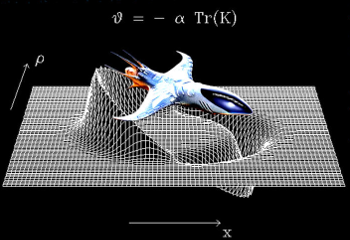 This theoretical design compresses spacetime ahead of a vessel and expands it behind, enabling apparent FTL travel without violating local light-speed limits.
Credit: tvtropes.org
This theoretical design compresses spacetime ahead of a vessel and expands it behind, enabling apparent FTL travel without violating local light-speed limits.
Credit: tvtropes.org
Common Misconceptions About FTL Physics
Several persistent myths blur the line between real physics and sci-fi when it comes to FTL:
- Myth: Quantum entanglement allows FTL communication. Entangled particles have correlated measurement outcomes, but there is no way to control the result of a measurement, so no information can be transmitted faster than light via entanglement. This is a fundamental rule of quantum mechanics confirmed by repeated experimentation.
- Myth: The 2011 OPERA neutrino experiment proved FTL was possible. The experiment initially detected neutrinos arriving 60 nanoseconds faster than light, but the result was later traced to a loose fiber optic cable causing a timing error. Follow-up tests confirmed neutrinos obey the light-speed limit, as confirmed by CERN’s official report on the anomaly.
- Myth: Warp drives are just a few decades away from becoming reality. Even if we could produce negative energy in large quantities, the energy requirements for a functional warp drive are so astronomical that they are unlikely to be achievable for thousands of years, if ever.
Biological Barriers to Human Survival at Relativistic Speeds
Even if we could somehow bypass the light-speed limit, the human body is woefully unequipped to survive the conditions of FTL travel. These biological barriers are just as insurmountable as the physical ones, at least with our current understanding of human physiology. You can also read our guide on how to survive medical technology.
G-Forces and Acceleration Stress
To reach relativistic speeds, you would need to accelerate at incredible rates, exposing your body to g-forces far beyond what a human can survive. A trained pilot in a pressurized suit can withstand up to 9g (9 times Earth’s gravity) for 10–20 seconds before losing consciousness, and fatal organ damage occurs in under a minute at that level. To accelerate to 0.9c at a comfortable 1g (Earth’s gravity) would take 1 year of ship time, but any faster acceleration would turn your organs to jelly. Deceleration at the end of your journey would require the same forces, meaning you cannot simply “zoom” to a destination and stop instantly. The forces involved would be far more lethal than those experienced in high-stress survival scenarios like high-speed crashes or animal attacks.
Interstellar Debris and Radiation Exposure
At 10% of light speed, a collision with a 1-gram pebble of interstellar dust would release energy equivalent to a small nuclear bomb, enough to vaporize an unshielded spacecraft. At FTL speeds, the energy of impacting particles would be even more extreme, as their kinetic energy increases exponentially with velocity. Even tiny hydrogen atoms floating in interstellar space would become deadly projectiles, and the radiation from these impacts would irradiate any crew member almost instantly, even with heavy shielding. Even the best specialized survival gear available today would be useless against this level of energy.
Time Dilation and Biological Aging
While time dilation would cause you to age slower than people on Earth during relativistic travel, it creates as many problems as it solves. Your biological processes, from cell division to circadian rhythms, would become desynchronized from Earth’s time frame, leading to severe physiological and psychological stress. If FTL travel were possible, some theoretical models suggest it would allow travel backward in time, creating paradoxes that would have unpredictable effects on biological systems. For crews on even slow interstellar missions, long-term survival planning would need to account for decades or centuries of time passing on Earth while crew members experience only a few years.
 Special relativity predicts time passes slower for objects moving near light speed relative to stationary observers, an effect confirmed by atomic clock experiments on fast-moving aircraft and satellites.
Credit: medium.com
Special relativity predicts time passes slower for objects moving near light speed relative to stationary observers, an effect confirmed by atomic clock experiments on fast-moving aircraft and satellites.
Credit: medium.com
Experimental Evidence and Current Scientific Consensus
The question of whether humans can survive FTL travel is not just theoretical—it is answered by over a century of experimental evidence confirming the light-speed limit for massive objects.
Particle Accelerator Tests of Relativity
Particle accelerators like the Large Hadron Collider (LHC) can accelerate subatomic particles to 99.9999991% of the speed of light, with energies of up to 6.5 tera-electronvolts per proton. No massive particle has ever been observed to exceed c, even under these extreme conditions. These experiments confirm that the energy required to accelerate an object with mass grows exponentially as it approaches c, making the speed limit unbreakable for any object larger than a subatomic particle. In practice, every test of special relativity over the past 120 years has validated the light-speed limit, with no credible exceptions ever recorded.
Debunked FTL Claims
The only widely publicized claim of FTL travel came in 2011, when the OPERA experiment at CERN initially reported that neutrinos had traveled from Switzerland to Italy 60 nanoseconds faster than light. The result sparked global excitement, but was later traced to a loose fiber optic cable that caused a timing error. Follow-up tests with corrected equipment confirmed neutrinos obey the light-speed limit, as predicted by relativity.
Why No FTL Breakthroughs Have Materialized
Despite decades of research into theoretical FTL concepts, no experimental evidence has emerged to suggest the light-speed limit can be bypassed for massive objects. Every test of special and general relativity has confirmed its predictions, and no peer-reviewed research has demonstrated a feasible path to FTL travel for humans. As of 2026, FTL travel remains a mathematical curiosity, not a practical possibility. Even the most advanced survival tech we can conceptualize is nowhere near capable of withstanding the conditions required for FTL travel.
Practical Technological Barriers to FTL Travel
Even if we ignore the fundamental physics limits, the practical technological barriers to FTL travel are so extreme that they are effectively insurmountable with any technology we can realistically envision.
Current Propulsion Limitations
Our fastest spacecraft to date, the Parker Solar Probe, reached a top speed of 192,000 m/s (0.064% of c) during its closest pass to the Sun, using gravitational assists from Venus. Chemical rockets max out at ~0.0001% of c, while even advanced nuclear thermal or ion thrusters would take thousands of years to reach the nearest star, let alone achieve relativistic speeds. No existing or near-term propulsion technology can accelerate a manned spacecraft to even 1% of the speed of light.
Astronomical Energy Requirements
The energy required to accelerate a 1,000kg spacecraft to 0.9c is roughly 1.2 x 10²⁰ joules, equivalent to 20 times the total annual energy consumption of the entire human population as of 2026. To reach c would require infinite energy, and even theoretical FTL concepts like the Alcubierre drive require energy equivalent to the mass of Jupiter, a quantity we cannot produce or store with any known technology. NASA’s official breakdown of special relativity notes that these energy requirements make FTL travel effectively impossible for any foreseeable human civilization.
Shielding and Life Support Challenges
Even if you could accelerate to relativistic speeds, protecting the crew from interstellar debris and radiation would require shielding far beyond our current engineering capabilities. At 10% of light speed, a collision with a 1-gram pebble of interstellar dust releases energy equivalent to a small nuclear bomb, making shielding a critical unsolved challenge for relativistic travel. Life support systems would also need to operate flawlessly for decades or centuries with no possibility of resupply, a challenge we have not yet solved for multi-year Mars missions, let alone interstellar travel. Just as you’d assemble hurricane kit essentials for extreme weather, surviving a relativistic space journey would require redundant systems far beyond current engineering.
 At 10% of light speed, a collision with a 1-gram pebble of interstellar dust releases energy equivalent to a small nuclear bomb, making shielding a critical unsolved challenge for relativistic travel.
Credit: www.reddit.com
At 10% of light speed, a collision with a 1-gram pebble of interstellar dust releases energy equivalent to a small nuclear bomb, making shielding a critical unsolved challenge for relativistic travel.
Credit: www.reddit.com
Frequently Asked Questions
Can humans physically travel faster than light?
No. Under Einstein’s theory of special relativity, accelerating any object with mass to the speed of light would require infinite energy, a physical impossibility with known laws of physics and technology. All experimental tests to date confirm this limit holds for everything from subatomic particles to macroscopic objects.
What happens to the human body near light speed?
At 90% of light speed, time dilation would cause 1 year of ship time to pass for every 2.3 years on Earth, but acceleration forces would be the immediate threat: even a sustained 10g acceleration (10 times Earth’s gravity) would cause unconsciousness in 10 seconds and fatal organ damage in under a minute. At relativistic speeds, collisions with interstellar hydrogen atoms would release enough energy to irradiate and kill a crew member in seconds without perfect shielding.
Is faster-than-light travel scientifically possible?
FTL travel as commonly depicted in science fiction (moving through local spacetime faster than c) is not possible under current physical models. Theoretical concepts like wormholes and warp drives do not violate relativity, but they rely on exotic matter with negative energy density, which has only been observed in tiny, laboratory-scale quantum effects, and cannot be produced in quantities large enough to power a spacecraft.
Could quantum entanglement enable FTL communication?
No. While entangled particles can have correlated states measured instantaneously across vast distances, there is no way to control the outcome of those measurements, so no information can be transmitted faster than light via entanglement. This is a fundamental rule of quantum mechanics confirmed by repeated experimentation.
What was the 2011 faster-than-light neutrino anomaly?
In 2011, the OPERA experiment at CERN initially reported that neutrinos had traveled from Switzerland to Italy 60 nanoseconds faster than light, sparking widespread excitement. The result was later traced to a loose fiber optic cable that caused a timing error, and subsequent tests confirmed neutrinos obey the light-speed limit.
Final Verdict: Can a Human Survive Faster-Than-Light Travel?
As of 2026, the answer is a definitive no, based on over a century of experimental confirmation of Einstein’s theory of relativity. The light-speed limit is not an arbitrary technical hurdle—it is a fundamental property of our universe, enforced by the relationship between mass, energy, and spacetime. No existing or theoretically plausible technology can bypass this limit for massive objects like human beings, and the biological, energetic, and technological barriers to even approaching light speed are far beyond our current capabilities.
Theoretical concepts like warp drives and wormholes remain mathematically possible under general relativity, but they rely on exotic materials and energy sources we have no way to produce or observe at scale. Even if these concepts could be realized, they would not involve moving a spacecraft through local spacetime faster than light, so the “faster-than-light travel” depicted in most science fiction remains impossible.
For now, human survival beyond our solar system will rely on slow, energy-efficient propulsion systems and advanced life support, not FTL travel. If you’re fascinated by the extreme limits of human survival and the science pushing those boundaries, explore our deep dive into long-term survival planning for extreme scenarios to see how we prepare for conditions that push human biology to its limits.