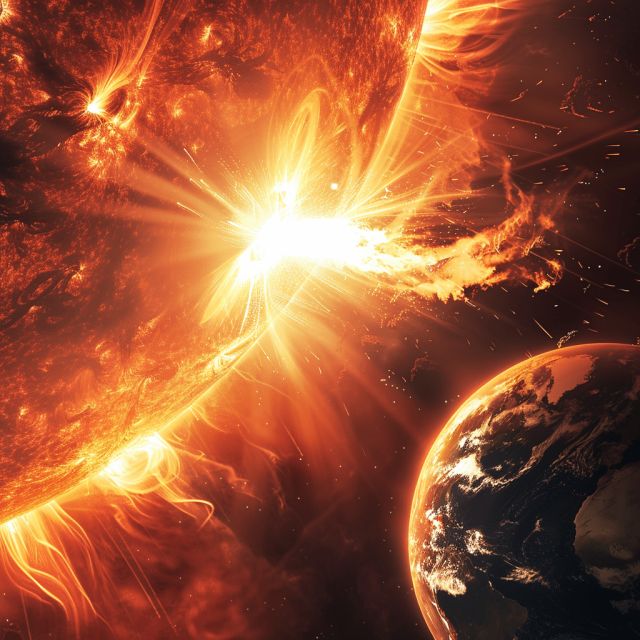
Can Humans Survive a Solar Flare: Shocking Truth Revealed
When a massive solar flare erupts from the sun, it can feel like a distant, sci-fi threat — but these cosmic bursts have real, tangible impacts on our daily lives. The 1859 Carrington Event, the strongest solar storm on record, caused auroras visible as far south as Cuba and set telegraph offices on fire across the globe. A similar event today would trigger trillions in infrastructure damage and widespread, long-term outages. But would humans actually survive? The shocking truth is that for people on Earth’s surface, direct survival is all but guaranteed — the real risk lies in our heavy reliance on technology that solar flares can disable. We’ll break down exactly how solar flares work, who faces real risk, and what you can do to stay safe.
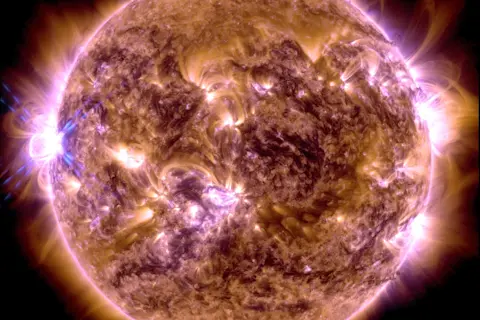 Caption: This bright X-class solar flare erupted from the sun’s surface, releasing massive amounts of electromagnetic radiation into space.
Credit: www.discovermagazine.com
Caption: This bright X-class solar flare erupted from the sun’s surface, releasing massive amounts of electromagnetic radiation into space.
Credit: www.discovermagazine.com
What Are Solar Flares, Anyway?
Solar flares are sudden, intense bursts of electromagnetic radiation (X-rays, ultraviolet light, radio waves) emitted from the sun’s surface during a magnetic reconnection event near sunspots. This release of energy is equivalent to billions of nuclear bombs detonating at once, and the radiation travels at the speed of light, reaching Earth in just 8 minutes. You can also read our guide on masked forces zombie survival unblocked games.
Solar Flare Basics & Classification
Solar flares are ranked by their X-ray brightness, with each class 10 times more powerful than the last:
- A-class and B-class: Weak, low-energy flares with no noticeable impact on Earth
- C-class: Moderate flares that may cause minor, short-lived radio blackouts near the poles
- M-class: Medium-strength flares that can cause brief, high-frequency radio blackouts for polar flights
- X-class: The strongest flares, capable of triggering widespread communication disruptions and, if paired with a coronal mass ejection (CME), severe geomagnetic storms
We are currently in Solar Cycle 25, which peaked between 2024 and 2025, meaning strong flare activity is more frequent during this period. NASA’s Solar Dynamics Observatory tracks solar activity in real time, providing critical data for space weather forecasts.
How Solar Flares Form
Solar flares occur when the sun’s magnetic field twists and tangles near sunspots, eventually snapping and releasing massive amounts of stored magnetic energy as radiation. This process, called magnetic reconnection, happens in the sun’s corona (outer atmosphere) and can last from minutes to hours. Flares are most common near the solar maximum, the peak of the sun’s 11-year activity cycle. You can also read our guide on underground survival shelters concrete bunkers.
Flares vs. Coronal Mass Ejections (CMEs): A Critical Distinction
A common point of confusion is the difference between solar flares and CMEs. A solar flare is a burst of electromagnetic radiation that travels at light speed, so we only know it has occurred 8 minutes after it happens. A CME is a separate event: a cloud of billions of tons of charged solar particles that can be ejected during or after a flare, traveling at 1–3 million miles per hour and taking 1–3 days to reach Earth. CMEs are the primary cause of widespread power grid damage and long-lasting geomagnetic storms, not flares themselves.
How Solar Flares Interact With Earth
Earth has two primary natural defenses against solar radiation: its magnetic field (magnetosphere) and its atmosphere. These layers work together to block nearly all harmful radiation from reaching the surface, but they are not completely impenetrable during extreme events. You can also read our guide on survival kits emergency preparedness kit red cross.
The Magnetosphere: Our First Line of Defense
The magnetosphere is a giant, invisible magnetic bubble surrounding Earth that deflects most charged solar particles away from the planet. During strong solar events, however, the magnetosphere can be compressed, temporarily exposing polar regions to higher levels of radiation. This interaction also creates the aurora borealis and aurora australis (northern and southern lights), visible signs of solar particles colliding with atmospheric gases. While auroras are beautiful, they indicate where solar storm impacts are strongest.
Ionosphere Disruptions & Communication Blackouts
The ionosphere, a charged layer of Earth’s upper atmosphere, absorbs X-ray and ultraviolet radiation from solar flares. This absorption increases ionization in the ionosphere’s D-layer, which absorbs high-frequency (HF) radio waves instead of reflecting them back to Earth. The result is a shortwave radio blackout that can last from minutes to hours, disrupting aviation, maritime, and emergency communications, especially near the poles. GPS signals can also become less accurate during these events, dropping from meter-level precision to tens of meters.
Radiation Exposure for Humans on Earth
The atmosphere blocks nearly all harmful radiation from solar flares, even X-class events. The extra radiation dose a person on Earth’s surface would receive from the strongest recorded flare is less than 1 millisievert (mSv) — less than the natural background radiation most people absorb in a year, and a fraction of the dose from a single diagnostic CT scan. There is no evidence that solar flares cause direct health harm to people on the ground, even during extreme events.
 Caption: Auroras like this are caused by solar particles interacting with Earth's magnetosphere, a visible sign of solar storm activity.
Credit: interestingengineering.com
Caption: Auroras like this are caused by solar particles interacting with Earth's magnetosphere, a visible sign of solar storm activity.
Credit: interestingengineering.com
The Real Threat: Impacts on Modern Technology & Infrastructure
While solar flares pose almost no direct risk to human life on Earth’s surface, they can cause severe, widespread disruption to the technology and infrastructure our society relies on. These impacts are the primary safety concern during strong solar events.
Power Grid Failures & Geomagnetically Induced Currents
When a strong CME hits Earth’s magnetosphere, it can trigger a geomagnetic storm that induces powerful electric currents in long conductors like power grid transmission lines. These geomagnetically induced currents (GICs) can overload transformers, causing them to overheat and fail permanently. The 1989 Quebec blackout, triggered by a CME, left 6 million people without power for 9 hours and caused an estimated $2 billion in damage. Modern interconnected grids are even more vulnerable to GICs, particularly in high-latitude regions like the northern U.S., Canada, and Scandinavia.
Satellite Damage & Navigation Disruptions
Charged particles from solar storms can cause single event upsets (SEUs) in satellite electronics, flipping binary bits and causing satellites to malfunction or go into safe mode. In extreme cases, particles can cause permanent hardware damage, leading to total satellite loss. Solar storms also heat the upper atmosphere, increasing drag on low Earth orbit satellites and forcing operators to use extra fuel to maintain their orbits, shortening satellite lifespans. GPS accuracy can drop from 1–3 meters to 50+ meters during strong storms, disrupting aviation, shipping, precision agriculture, and emergency response systems.
Communication System Outages
In addition to HF radio blackouts from flare radiation, CME-driven geomagnetic storms can disrupt undersea communication cables, which use repeaters powered by shore-based electricity. A severe storm could cause outages for internet and phone service in coastal regions for days or weeks, depending on damage severity.
Survival Scenarios for People on Earth
For the vast majority of people, a solar flare event will not be life-threatening. The main risks are temporary loss of power, communications, and navigation, which can be mitigated with simple preparedness steps.
Natural Protection Factors That Keep Us Safe
Earth’s magnetosphere and atmosphere block nearly all harmful radiation from solar flares, even the strongest X-class events. The ozone layer also absorbs increased ultraviolet radiation from flares, so there is no risk of sunburn or radiation sickness for people on the surface. The only people at risk of direct radiation harm are astronauts in deep space and people on high-altitude polar flights during strong solar storms.
Practical Preparedness Steps for Solar Storms
For most solar events, no special action is needed beyond staying aware of space weather forecasts from official sources like NOAA. For strong geomagnetic storm warnings (issued 1–3 days in advance for incoming CMEs), take these simple steps to reduce disruption:
- Unplug sensitive electronics (computers, TVs, appliances) to avoid damage from power surges
- Keep a 72-hour emergency kit stocked with non-perishable food, water, a battery-powered radio, and manual tools
- Fill your car’s gas tank and have cash on hand, as card readers and gas pumps will not work during power outages
- Have a reliable survival knife and manual tools on hand for emergency tasks like cutting food or clearing debris
- Stock up on hurricane kit essentials that include critical supplies for extended disruptions
Extreme Event Risk: What If a Carrington-Class Storm Hits?
The shocking truth most people don’t realize is that a Carrington-class solar storm (the strongest on record) would not cause mass casualties from radiation. The real risk is catastrophic, long-term infrastructure failure: widespread power outages lasting weeks or months, disruption to global supply chains, and loss of access to clean water and food in some areas. Survival for people on the surface would still be near-certain for most, but daily life would be drastically disrupted for an extended period. Investing in long-term survival supplies and supporting grid hardening initiatives in your community can reduce this risk.
Solar Flare Risks for Astronauts & Space Travelers
The only humans at meaningful risk of direct harm from solar flares are astronauts operating outside Earth’s protective magnetosphere. For these space travelers, a strong solar event can deliver a lethal radiation dose in a matter of hours without proper shielding.
Low Earth Orbit: Manageable but Not Risk-Free
Astronauts on the International Space Station (ISS) are partially protected by Earth’s magnetosphere, but they still face elevated radiation risk during strong solar events. During warnings of incoming CMEs, the crew takes shelter in the station’s most shielded module (the Russian segment, which has extra water and supplies for radiation blocking) to avoid acute radiation sickness. The FAA limits total radiation exposure for astronauts to 1,000 mSv over their career, equivalent to 200+ chest CT scans, and space agencies carefully monitor solar activity to minimize exposure during missions.
Deep Space Missions: Unprecedented Radiation Hazards
For missions to the Moon or Mars, there is no magnetospheric protection, so a Carrington-class solar event could deliver a lethal radiation dose to unprotected astronauts in under 10 hours. NASA’s Artemis program, which aims to return humans to the moon as early as 2027, includes dedicated radiation storm shelters on the Orion spacecraft designed to protect crews from even the strongest solar events. For future Mars missions, which require 6–9 months of travel time each way, engineers are developing active shielding systems and real-time solar monitoring to keep crews safe.
Emerging Shielding & Mitigation Technologies
Research into radiation shielding is advancing rapidly: new materials like hydrogen-rich composites and water-filled barriers can block charged particles more effectively than traditional aluminum shielding. Private space companies are also developing active shielding systems that use electromagnetic fields to deflect charged particles, similar to Earth’s magnetosphere. These innovations will be critical for making long-term deep space exploration safe.
Future Advances in Solar Monitoring & Warning Systems
Solar weather forecasting has improved dramatically in recent years, and ongoing research is making us even more resilient to solar storm impacts.
Improved Forecasting & Early Warning Capabilities
NOAA’s Space Weather Prediction Center now issues forecasts up to 45 days in advance of potential solar storms, a major improvement over the 1–3 day warnings available a decade ago. Artificial intelligence is being used to analyze solar imagery and predict flare activity with higher accuracy, giving utilities, airlines, and satellite operators more time to take protective action. For the general public, official alerts are available via the NOAA app and emergency alert systems, so you can receive warning of incoming storms hours or days in advance.
Grid Hardening & Infrastructure Resilience
Utilities around the world are installing GIC blockers on power grid transformers, which prevent damaging currents from flowing into the grid during geomagnetic storms. These upgrades would reduce the impact of a Carrington-class event by up to 80% in regions with modernized infrastructure. Satellite manufacturers are also building more radiation-hardened electronics and redundant systems to survive solar particle events, reducing the risk of permanent satellite loss during storms.
Frequently Asked Questions
What Is A Solar Flare And How Does It Affect Earth?
A solar flare is a sudden, intense burst of electromagnetic radiation emitted from the sun’s surface during a magnetic reconnection event near sunspots. While the radiation travels at light speed and reaches Earth in 8 minutes, our atmosphere and magnetosphere block nearly all harmful radiation from reaching the surface. The main near-Earth effects are shortwave radio blackouts (lasting minutes to hours) and increased radiation exposure for high-altitude flights and astronauts in space. Strong flares are often accompanied by CMEs, which can trigger widespread geomagnetic storms and infrastructure damage.
Can Humans Survive The Radiation From A Solar Flare?
For people on Earth’s surface, survival is all but guaranteed. Even the strongest recorded X-class solar flare would deliver less than 1 mSv of extra radiation to a person on the ground — less than the natural background radiation most people receive in a year, and far less than a single diagnostic CT scan. The only groups at meaningful risk are astronauts outside Earth’s magnetosphere (who can receive lethal radiation doses during extreme events without proper shielding) and people on high-altitude polar flights during strong solar storms, who may receive an extra 0.1–0.5 mSv of exposure. Regulatory bodies like the FAA monitor space weather and reroute flights to lower latitudes during high-risk events to minimize exposure. For additional guidance on building a hurricane preparedness checklist for extended disruptions, refer to our full emergency kit guide.
How Do Solar Flares Impact Modern Technology And Safety?
Solar flares and their associated CMEs pose three primary risks to modern technology: 1) Shortwave radio blackouts that disrupt aviation, maritime, and emergency communications for hours at a time; 2) Geomagnetically induced currents that overload power grid transformers, potentially causing widespread, long-lasting blackouts; 3) Single event upsets that damage satellite electronics, disrupt GPS navigation, and increase atmospheric drag that shortens satellite lifespans. While these disruptions rarely cause direct physical harm to people, they can compromise critical safety systems like emergency response communications and air traffic control. Keeping a long-term survival kit at home can help you stay functional during extended outages.
Are There Protective Measures Against Solar Flare Effects?
Yes, multiple layers of protection exist for both individuals and infrastructure. For power grids, utilities are installing GIC blockers and transformers that can withstand geomagnetic storms, which would reduce the impact of a Carrington-class event by up to 80%. For satellites, manufacturers use radiation-hardened electronics and design redundant systems to survive solar particle events. For individuals, simple steps like using surge protectors for electronics, keeping a 72-hour emergency kit on hand, and monitoring official space weather alerts from NOAA can minimize disruption. For astronauts, space stations and spacecraft have dedicated shielded "storm shelters" where crews can take cover during strong solar events. For extended outages, having off-grid survival gear like solar chargers and manual tools can keep you functional without access to grid power.
Final Takeaway
The shocking truth about solar flares is that they are almost never a direct threat to human survival for people on Earth’s surface. Our planet’s magnetosphere and atmosphere are incredibly effective shields against solar radiation, and even the strongest recorded flares pose no risk of radiation sickness for ground dwellers. The real risk lies in our reliance on vulnerable technology and infrastructure, which could be severely disrupted by an extreme, once-in-a-century Carrington-class event.
Preparedness for solar storms is simple: stay informed via official sources like the NOAA Space Weather Prediction Center, keep a basic emergency kit on hand, and take simple steps like unplugging electronics during strong storm warnings. For most people, a solar flare event will be a minor inconvenience, not a life-threatening disaster. By understanding the real risks and taking small, proactive steps, you can easily survive even the most powerful solar storms the sun can throw at us.
Stay informed about space weather risks and build your emergency plan today using our free survival preparedness resources.