How Many Water Barrels Survival Experts Recommend For Emergency Preparedness
Water is the single most critical supply for emergency survival, yet it’s often overlooked in basic preparedness planning. Public water systems can be disrupted for days to weeks after hurricanes, earthquakes, or infrastructure failures, and boil water advisories are common in the aftermath of major disasters. The CDC recommends every household store at least 1 gallon of water per person per day for drinking, basic hygiene, and light cooking during emergencies, and survival experts universally agree a minimum 2-week supply is the baseline for shelter-in-place scenarios. This guide breaks down exactly how many water barrels you need, how to store them safely, and which products pair best with your stockpile.
Why Water Storage Is Non-Negotiable For Emergencies
Dehydration sets in fast, especially in hot weather or during physically demanding disaster response like cleanup or evacuation. A 2024 FEMA assessment found that 68% of households affected by major hurricanes lost running water for 7 or more days, and 32% of earthquake-affected regions faced water outages for 3 weeks or longer. Stored water eliminates the risk of relying on contaminated local sources or waiting for aid deliveries, which can be delayed or inaccessible in widespread disasters. Unlike non-perishable food, which can be rationed for weeks, humans can only survive 3 days without clean water, making it the highest-priority supply in any emergency kit. You can also read our guide on emergency preparedness survival backpack kits.
Calculating Your Household's Exact Water Barrel Needs
The exact number of barrels you need depends on your household size, pets, climate, and regional disaster risk. Follow this step-by-step calculation to get an accurate count:
- Start with the base per-person requirement: 1 gallon per person per day, per CDC guidance. This covers 1 quart for drinking, 1 quart for basic hygiene (handwashing, teeth brushing), and 2 quarts for light cooking (boiling oatmeal or rehydrating meals).
- Adjust for special needs: Add 0.5 gallons per person per day if you live in a hot, dry climate; have pregnant or nursing household members; or plan to cook full meals (not just rehydrate) during an outage. Add 0.5 gallons per person per day for elderly or disabled household members who may need extra water for medical care or hygiene.
- Add for pets: Include 1 quart of water per 10 lbs of pet weight per day. A 50-lb dog, for example, needs 1.25 gallons of water per day.
- Set your minimum supply goal: Aim for 2 weeks of water for standard risk areas, or 3-4 weeks if you live in a hurricane or earthquake zone where infrastructure repairs take longer. For households in coastal areas, align your water stockpile with hurricane-specific supply guidance to account for extended outage risks.
Concrete Examples For Common Households
- Single adult, no pets, mild climate: 14 gallons minimum (1 standard 55-gallon barrel covers this with 41 gallons of extra buffer)
- Family of 4, no pets: 56 gallons (2 55-gallon barrels)
- Family of 4 with 2 50-lb dogs: 84 gallons (2 55-gallon barrels + 1 30-gallon portable jug, or 2 60-gallon bathtub bladders)
- Family of 6 with 1 infant and 2 medium dogs: 126 gallons (3 55-gallon barrels, or 2 55-gallon barrels + 2 60-gallon bathtub bladders)
A common mistake new preppers make is storing full 55-gallon barrels in an attic or second-floor closet: a single full barrel weighs ~460 lbs, which can damage flooring or make it impossible to move during an emergency. Always store heavy barrels on a ground floor or reinforced surface, on a wooden pallet to prevent chemical leaching from concrete.
Critical Factors That Change Your Barrel Count
Several variables will shift your final barrel count beyond basic household size:
- Space constraints: If you don’t have space for multiple 55-gallon barrels, supplement with stackable tanks or bathtub bladders to hit your total gallon goal without cluttering your home.
- Evacuation plans: If you may need to leave your home during an emergency, prioritize portable water options (pouches, small jugs) for your go-bag, which you can build using our core go-bag essentials checklist.
- Water access alternatives: If you have a nearby well, rainwater collection system, or natural water source, you can reduce your stored barrel count, but you’ll still need treatment supplies to make that water safe to drink.
Best Practices For Storing Water Barrels Long-Term
Proper storage is just as important as having the right number of barrels, as incorrectly stored water can become contaminated or undrinkable when you need it most:
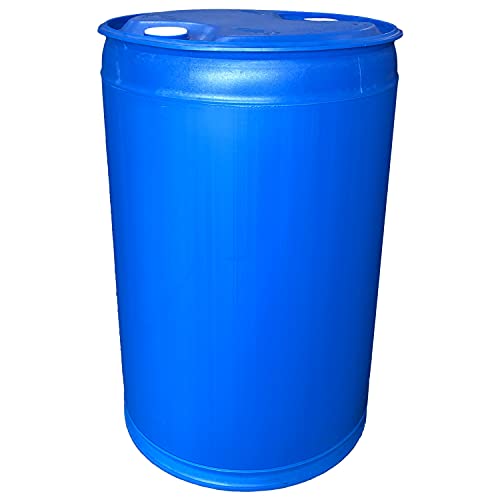
- Only use food-grade, BPA-free barrels with airtight, tamper-proof bungs. Opaque blue barrels are the industry standard, as they block UV light that causes algae growth.
- Store barrels in a cool, dark area (50-70°F is ideal) away from direct sunlight, gasoline, pesticides, or other chemicals that could leach into the water.
- Place barrels on a wooden pallet if storing on concrete to prevent chemical leaching from the concrete into the plastic.
- Check seals every 6 months for cracks or looseness, and tighten as needed with a bung wrench.
- If not using a water preserver, rotate untreated water every 6-12 months to keep it fresh. Treated water can last 5 years or more with no rotation needed.
- Label each barrel with the fill date and treatment date, so you know when to rotate or re-treat. To find the right preserver for your stockpile, review our long-term water treatment options guide.
Top Recommended Water Storage Solutions To Pair With Your Barrel Count
The right storage solution depends on your space, budget, and evacuation plans. Below are the most reliable options for 2026, all tested for safety and durability by prepper communities.
Augason Farms 55-Gallon Water Storage Barrel
The Augason Farms 55-Gallon Water Storage Barrel is a popular entry-level option for new preppers building their first at-home water stockpile. Its BPA-free construction meets FDA standards for food contact, and its 35.5” height fits easily in most basements, garages, or under staircases. It holds up to 55 gallons of water, enough to supply one person for 55 days at the minimum 1-gallon-per-day rate, or a family of 4 for 2 weeks.
Pros
- BPA-free, FDA-compliant material ensures no chemical leaching into stored water
- Compact 35.5” height fits in most residential storage spaces
- Lightweight empty design (18 lbs) makes it easier to move into place before filling
- Durable blue plastic resists UV damage and punctures
Cons
- Does not include a spigot or siphon, so you’ll need to purchase a separate dispensing tool to avoid lifting the 460-lb full barrel
- Requires manual sealing with a bung wrench (not included) to ensure an airtight fit
- Large footprint may be difficult to fit in small apartments or shared living spaces
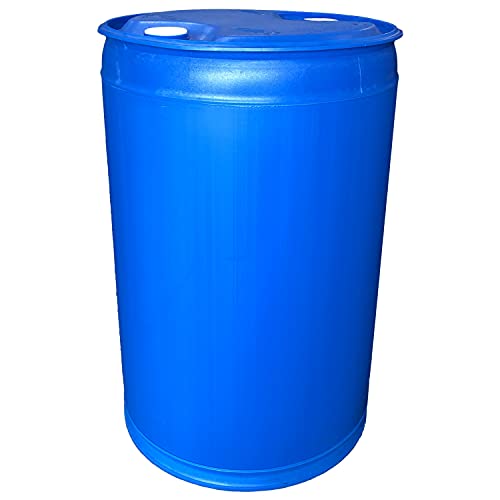 Entry-level 55-gallon barrel ideal for first-time preppers building at-home water reserves
Shop Augason Farms 55-Gallon Barrel
55 Gallon Water Preserver Concentrate (5-Year Formula)
For anyone storing water for longer than 6 months, an EPA-approved water preserver eliminates the need for frequent rotation. This 5-year formula is designed specifically for 55-gallon barrels, and a single bottle treats up to 55 gallons of water when stored in a cool, dark place. It inhibits bacterial and algae growth, keeping water safe to drink for up to 5 years without re-treatment.
Pros
- Extends stored water shelf life to 5 years with proper dosing
- Easy-to-use drop formula requires no special equipment
- Effective against common water contaminants like E. coli and giardia
- Compact 5.4” height fits easily in emergency supply kits
Cons
- Requires precise dosing (1 capful per 55 gallons) to work effectively
- Not suitable for immediate consumption; water must be treated before drinking
- Multiple bottles are needed if you store more than 55 gallons of water
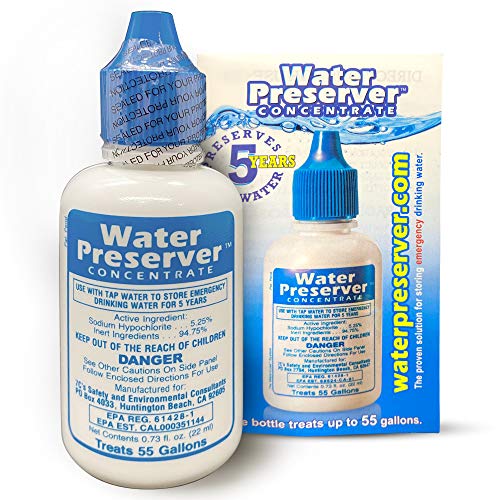 Water preserver concentrate extends stored water shelf life to 5 years with proper dosing
Shop 5-Year Water Preserver
BayTec 55-Gallon Emergency Water Barrel Storage Combo Pack
The BayTec 55-Gallon Combo Pack is a turnkey solution for preppers who want all the necessary accessories included upfront. It pairs a durable 55-gallon barrel made by Core Plastics with a siphon hose, bung wrench, and a bottle of Purogene water treatment, so you don’t have to source parts separately. It’s a good choice for first-time preppers who may not know what extra tools they need for water storage.
Pros
- Includes all required accessories (siphon, wrench, treatment) out of the box
- Purogene water treatment is EPA-approved for long-term water preservation
- Durable 35” height barrel fits in most standard storage spaces
- Blue opaque plastic blocks UV light to prevent algae growth
Cons
- Full barrel weight (460 lbs) requires a sturdy, ground-level storage surface
- Siphon hose may need to be replaced after 2-3 years of use
- Higher upfront cost than buying a bare barrel and accessories separately
 All-in-one water storage kit with barrel, siphon, and treatment included
Shop BayTec Combo Pack
SurvivalKitsOnline 55 Gallon Water Preserver Concentrate
This budget-friendly water preserver from SurvivalKitsOnline is a cost-effective option for treating multiple 55-gallon barrels. Its concentrated formula works for both drinking water and utility water (for flushing toilets or cleaning during outages), making it a versatile addition to your preparedness supply. A single bottle treats up to 55 gallons of water, and it has a 5-year shelf life unopened.
Pros
- Lower cost per treatment than name-brand preservers for bulk use
- Works for both drinking and non-potable utility water
- 5-year unopened shelf life means you can stock it long-term
- Simple drop formula requires no mixing or special tools
Cons
- Dosing instructions are less detailed than premium brands, so new users may need to measure carefully
- Not EPA-listed for use in all municipal water systems (check local guidelines if you use treated municipal water)
- Smaller bottle size means you’ll need multiple bottles for large water stockpiles
Budget-friendly water preserver suitable for treating multiple storage barrels
Shop SurvivalKitsOnline Preserver
Datrex Emergency Water Packet (18-Pack)
These small, leak-proof pouches are a must-have for go-bags, vehicle emergency kits, and office disaster supplies. Each 4.227 oz pouch meets US Coast Guard standards for emergency drinking water, and has a 5-year shelf life, so you can store them long-term without worrying about rotation. They’re lightweight and compact, making them easy to carry if you need to evacuate on foot.
Pros
- US Coast Guard-approved for emergency drinking water
- Leak-proof sealed packaging prevents spills and contamination
- 5-year shelf life with no rotation needed
- Compact size fits easily in backpacks, glove compartments, and desk drawers
Cons
- Small 4.227 oz size means you’ll need 6-8 pouches per person per day to meet hydration needs
- Higher cost per gallon than barrel-stored water
- Single-use packaging creates waste after consumption
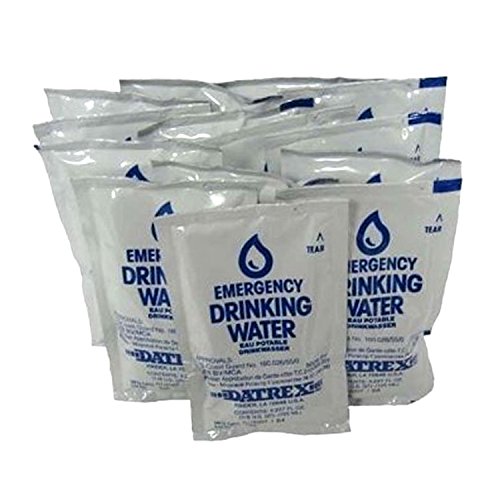 Compact leak-proof water pouches ideal for portable emergency kits
Shop Datrex 18-Pack Pouches
Godwolf Bathtub Drinking Water Bladder
If you don’t have space for permanent 55-gallon barrels, a bathtub bladder lets you use existing space to store 100 gallons of water in minutes before a predicted storm. It’s made of food-grade, BPA-free PVC that’s safe for drinking water, and fits most standard 60” x 30” bathtubs. It’s a great last-minute option for families who may not have time to fill and store multiple barrels before a hurricane warning.
Pros
- 100-gallon capacity stores enough water for a family of 4 for 12 days
- Fits standard bathtubs with no extra storage space required
- BPA-free, food-grade material is safe for drinking water
- Compact and lightweight when empty (1.7 lbs) for easy storage in a linen closet
Cons
- Requires a bathtub to set up, so it’s not suitable for homes with only showers
- Filling a full 100-gallon bladder can take 30+ minutes with a standard showerhead
- Can be difficult to move when full (100 gallons of water weighs ~800 lbs)
 100-gallon bathtub bladder for last-minute large-scale water storage before storms
Shop Godwolf Bathtub Bladder
Mayday 50-Pack Emergency Water Pouches
This 50-pack of 4.225 oz water pouches is a cost-effective bulk option for families or community emergency supplies. The leak-proof pouches are individually sealed, so you can distribute them across multiple go-bags, vehicle kits, and home supply closets. They have a 5-year shelf life, and are manufactured by Mayday Industries, a trusted brand in emergency preparedness.
Pros
- 5-year shelf life with no rotation needed
- Leak-proof sealed packaging prevents spills and contamination
- Bulk 50-pack is cost-effective for multi-person households or community groups
- Compact size fits easily in small storage spaces
Cons
- Small 4.225 oz size means you’ll need 6-8 pouches per person per day
- Single-use packaging creates waste after consumption
- Higher cost per gallon than barrel-stored water
 Bulk pack of long-shelf-life water pouches for multi-kit stocking
Shop Mayday 50-Pack Pouches
Datrex 64-Pack Emergency Survival Water Pouches
This 64-pack of 125ml water pouches is a compact option for individual go-bags or small group supplies. Each pouch is sealed to prevent contamination, and the slightly larger 125ml size reduces the number of pouches you need to carry per day compared to smaller 4oz options. The pack weighs 19 lbs total, making it easy to store in a car trunk or home supply closet.
Pros
- Larger 125ml size reduces the number of pouches needed per day (4-5 per person per day)
- Leak-proof sealed packaging prevents spills and contamination
- 5-year shelf life with no rotation needed
- Reputable Datrex brand meets US Coast Guard emergency water standards
Cons
- Full pack weight (19 lbs) may be bulky for small go-bags
- Higher cost per gallon than barrel-stored water
- Single-use packaging creates waste after consumption
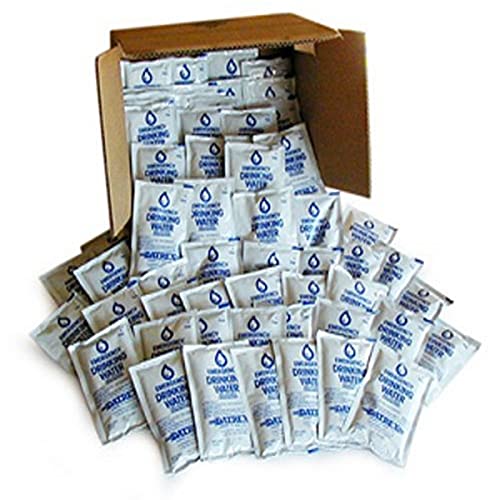 Compact 125ml water pouches for individual evacuation kit stocking
Shop Datrex 64-Pack Pouches
WaterPrepared Stackable 55-Gallon Water Storage Tank
If you need to store multiple 55-gallon barrels but have limited floor space, this stackable tank lets you store two barrels vertically, cutting your storage footprint in half. It includes two spigots for easy dispensing, and the opaque blue plastic blocks UV light to prevent algae growth. It’s a good option for preppers with basements or garages that have low ceiling clearance.
Pros
- Stackable design cuts storage footprint in half for multi-barrel stockpiles
- Includes two spigots for easy, no-lift water dispensing
- Opaque blue plastic blocks UV light to prevent algae growth
- Durable construction resists punctures and cracks
Cons
- Exact dimensions and weight are not listed by the manufacturer, so you’ll need to measure your storage space before purchasing
- Plastic may degrade over prolonged exposure to direct sunlight if stored outdoors
- Spigots may leak if not tightened properly after each use
 Stackable 55-gallon water tank for space-efficient at-home storage
Shop WaterPrepared Stackable Tank
2-Pack 60-Gallon Bathtub Water Storage Bladder
This 2-pack of 60-gallon bathtub bladders is a cost-effective option for families who want to store 120 gallons of water in their bathtubs before a predicted storm. The clear material lets you monitor water levels at a glance, and the BPA-free construction is safe for drinking water. Each bladder weighs only 1.7 lbs when empty, so they’re easy to store in a linen closet when not in use.
Pros
- 60-gallon capacity per bladder stores enough water for a family of 3 for 10 days
- BPA-free, food-grade material is safe for drinking water
- Clear material lets you monitor water levels easily
- Reusable design can be used multiple times before replacing
Cons
- Requires a standard bathtub to set up, so not suitable for homes with only showers
- Filling a full 60-gallon bladder can take 20+ minutes with a standard showerhead
- Can be difficult to move when full (60 gallons of water weighs ~500 lbs)
 2-pack of reusable bathtub bladders for large-scale pre-storm water storage
Shop 2-Pack Bathtub Bladders
Frequently Asked Questions
How Many Barrels Are Needed For Survival?
The exact number of barrels depends on your household size, pet count, and local climate. At the minimum CDC recommendation of 1 gallon per person per day, a single 55-gallon barrel supplies one person for 55 days, or a family of 4 for 2 weeks. If you have pets, add 1 quart of water per 10 lbs of pet weight per day to your total. For hot climates or households with extra hygiene needs, bump your per-person daily requirement to 1.5 gallons, which will increase your total barrel count. For households with limited space, supplement barrels with bathtub bladders or 5-gallon portable jugs to hit your target gallon count.
How Long Does Stored Water Last?
Untreated water stored in food-grade, opaque containers stays safe to drink for 6-12 months if kept in a cool, dark place away from direct sunlight. If you treat the water with an EPA-approved 5-year water preserver, it will stay safe for up to 5 years with no rotation needed. Always inspect stored water before use: discard any water that is cloudy, has an odd odor, or has visible sediment.
What Is The Best Way To Store Water?
Store water in food-grade, BPA-free barrels or containers with airtight, tamper-proof seals. Place barrels on a wooden pallet if storing on concrete to prevent chemical leaching, and keep them in a cool, dark area (50-70°F is ideal) away from direct sunlight, gasoline, pesticides, or other chemicals. Label each container with the fill and treatment date, and rotate untreated water every 6-12 months. For long-term storage, use a water preserver to avoid frequent rotation.
Can Water Barrels Be Used Indoors?
Yes, as long as you store them on a flat, reinforced surface. A full 55-gallon barrel weighs ~460 lbs, so avoid storing them in attics, on upper floors, or on weak flooring that could crack under the weight. Many preppers store barrels in basements, garages, or under indoor staircases for easy access. Place a leak-proof tray under each barrel to catch condensation or minor spills, and ensure the area is well-ventilated to prevent mold growth.
How To Treat Water For Long-term Storage?
The safest option for long-term storage is an EPA-approved water preserver concentrate, which inhibits bacterial and algae growth for up to 5 years. Follow the manufacturer’s dosing instructions exactly (typically 1 capful per 55 gallons of water). If you don’t have a preserver, you can use unscented household bleach (8 drops per gallon of clear water, 16 drops per gallon of cloudy water) for short-term treatment, but this only lasts 6 months. Never use scented bleach, bleach with added cleaners, or non-food-grade chemicals to treat drinking water.
What Emergency Water Options Are Available?
For long-term at-home storage, 55-gallon BPA-free barrels are the standard, most cost-effective option. For temporary or portable use, opt for sealed water pouches, 5-gallon portable jugs, or bathtub bladders. For evacuation, keep a 3-day supply of lightweight pouches in your go-bag, which you can stock using our portable emergency water picks guide. For households in storm zones, align your water stockpile with coastal emergency planning tips to account for extended outage risks.
Conclusion
The exact number of water barrels you need depends on your household’s unique needs, but the baseline recommendation from survival experts and public health agencies is 1 gallon per person per day, with a minimum 2-week supply for shelter-in-place scenarios. For most households, this translates to one 55-gallon barrel per person, or two 55-gallon barrels for a family of 4, with extra capacity added for pets, cooking, and hot climates. For long-term storage, pair your barrels with an EPA-approved water preserver to avoid frequent rotation, and store them in a cool, dark, ground-level space to keep water safe and accessible. If you have limited storage space, supplement barrels with bathtub bladders or stackable tanks to hit your target gallon count without cluttering your home. Don’t forget to add portable water pouches to your go-bag for evacuation scenarios, so you have access to water if you can’t reach your at-home stockpile. If you’re just starting your emergency preparedness journey, start with one 55-gallon barrel per household member, then expand your stockpile as your space and budget allow. For a full list of supplies to pair with your water reserves, review our go-bag packing checklist to build a complete, actionable emergency plan.